
Particle Tracking And Residence Times#
[2]:
# -*- coding: utf-8 -*-
"""
 * Copyright (c) 2023 Alexandre Gauvain, Ronan Abhervé, Jean-Raynald de Dreuzy
 *
 * This program and the accompanying materials are made available under the
 * terms of the Eclipse Public License 2.0 which is available at
 * http://www.eclipse.org/legal/epl-2.0, or the Apache License, Version 2.0
 * which is available at https://www.apache.org/licenses/LICENSE-2.0.
 *
 * SPDX-License-Identifier: EPL-2.0 OR Apache-2.0
"""
[2]:
'\n * Copyright (c) 2023 Alexandre Gauvain, Ronan Abhervé, Jean-Raynald de Dreuzy\n *\n * This program and the accompanying materials are made available under the\n * terms of the Eclipse Public License 2.0 which is available at\n * http://www.eclipse.org/legal/epl-2.0, or the Apache License, Version 2.0\n * which is available at https://www.apache.org/licenses/LICENSE-2.0.\n *\n * SPDX-License-Identifier: EPL-2.0 OR Apache-2.0\n'
[3]:
# Libraries installed by default
import sys
import os

import numpy as np
import pandas as pd

import geopandas as gpd
import matplotlib as mpl
import matplotlib.pyplot as plt
import rasterio
import imageio

import whitebox
wbt = whitebox.WhiteboxTools()
wbt.verbose = False

# ROOT DIRECTORY
from os.path import dirname, abspath
try:
    root_dir = '/home/bb/Documents/01_Git_Repository/01-HydroModPy-dev'
except NameError:
    root_dir = os.getcwd()
sys.path.append(root_dir)

# HYDROMODPY MODULES
from hydromodpy import watershed_root
from hydromodpy.display import visualization_watershed, visualization_results
from hydromodpy.tools import toolbox
fontprop = toolbox.plot_params(8,15,18,20)  # small, medium, interm, large
[4]:
example_path = os.path.join(root_dir, "examples", "06_particle_tracking_and_residence_times/")
data_path = os.path.join(example_path, "data/")

# The folder out_path is created in the example_path root directory:
out_path = os.path.join(root_dir,'examples', 'results')
# Or use a function to update the root folder
# out_path = folder_root.update_root_folder_results()
# Or define it manually
# out_path = 'C:/Simulations/HydroModPy/'

print('The results of the example will be saved here :', out_path)
The results of the example will be saved here : /home/bb/Documents/01_Git_Repository/01-HydroModPy-dev/examples/results
[ ]:
case = 'Example_06_Lasset'
# case = 'Example_06_Hillslope_1D'
# case = 'Example_06_Hillslope_2D'

if case == 'Example_06_Hillslope1D':
    dem_path = data_path + 'hillslope_1D.tif'
    load = False
    watershed_name = case
    from_lib = None # os.path.join(root_dir,'watershed_library.csv')
    from_dem = [dem_path, 10] # [path, cell size]
    from_shp = None # [path, buffer size]
    from_xyv = None # [x, y, snap distance, buffer size]
    bottom_path = None # path
    modflow_path = os.path.join(root_dir,'bin/')
    save_object = True

if case == 'Example_06_Hillslope2D':
    dem_path = data_path + 'hillslope_2D.tif'
    load = False
    watershed_name = case
    from_lib = None # os.path.join(root_dir,'watershed_library.csv')
    from_dem = [dem_path, 10] # [path, cell size]
    from_shp = None # [path, buffer size]
    from_xyv = None # [x, y, snap distance, buffer size]
    bottom_path = None # path
    modflow_path = os.path.join(root_dir,'bin/')
    save_object = True

if case == 'Example_06_Lasset':
    dem_path = data_path + 'regional dem.tif'
    load = True
    watershed_name = case
    from_lib = None # os.path.join(root_dir,'watershed_library.csv')
    from_dem = None # [path, cell size]
    from_shp = None # [path, buffer size]
    from_xyv = [601020,6193860,200,50,'EPSG:2154'] # [x, y, snap distance, buffer size]
    bottom_path = None # path
    modflow_path = os.path.join(root_dir,'bin/')
    save_object = True
[ ]:
print('##### '+watershed_name.upper()+' #####')

# load = True
BV = watershed_root.Watershed(dem_path=dem_path,
                              out_path=out_path,
                              load=load,
                              watershed_name=watershed_name,
                              from_lib=from_lib, # os.path.join(root_dir,'watershed_library.csv')
                              from_dem=from_dem, # [path, cell size]
                              from_shp=from_shp, # [path, buffer size]
                              from_xyv=from_xyv, # [x, y, snap distance, buffer size]
                              bottom_path=bottom_path, # path
                              save_object=save_object)

# Paths generated automatically but necessary for plots
stable_folder = out_path+'/'+watershed_name+'/'+'results_stable/'
simulations_folder = out_path+'/'+watershed_name+'/'+'results_simulations/'
[INFO]       __  __          __           __  ____          ________
[INFO]      / / / /         / /          /  \/   /         / / __  /
[INFO]     / /_/ /_  ______/ /________  /       /___  ____/ / /_/ /_  __
[INFO]    / __  / / / / __  / ___/ __ \/ /\,-/ / __ \/ __  / ____/ / / /
[INFO]   / / / / /_/ / /_/ / /  / /_/ / /   / / /_/ / /_/ / /   / /_/ /
[INFO]  /_/ /_/\__, /_____/_/   \____/_/   /_/\____/_____/_/____\__, /
[INFO]        /____/ Hydrological Modelling in Python /_____________/
[INFO]
[INFO] Python object was successfully loaded as requested; imported from output directory /home/bb/Documents/01_Git_Repository/01-HydroModPy-dev/examples/results/Example_06_Lasset
##### EXAMPLE_06_LASSET #####
[7]:
# # Necessary to set model parameters
BV.add_climatic()

# Different cases of recharge implementation
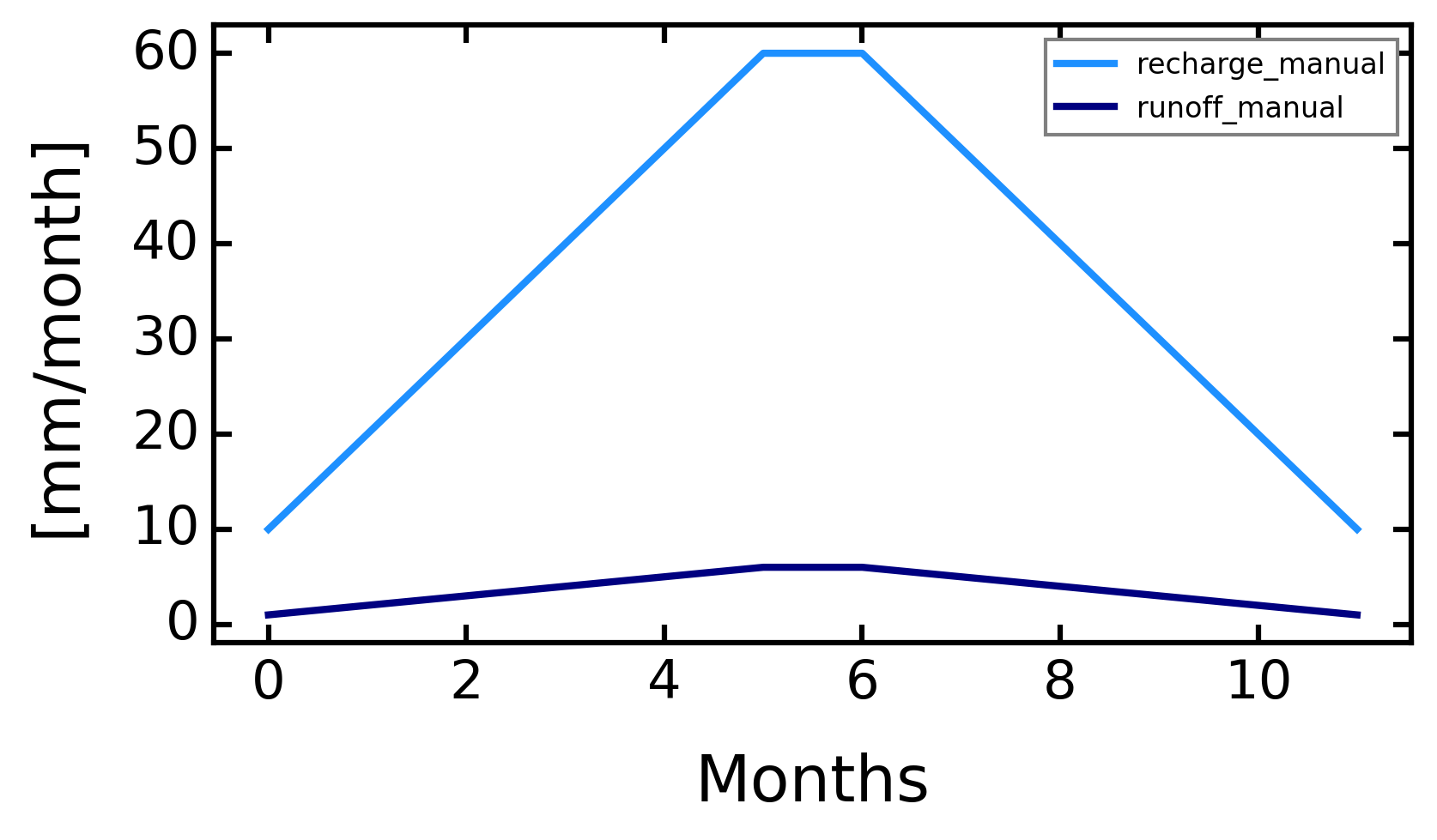
time_series = pd.Series([10,20,30,40,50,60,60,50,40,30,20,10])
BV.climatic.update_recharge(time_series, sim_state='transient')
fig, ax = plt.subplots(1,1, figsize=(6,3))
R = BV.climatic.recharge
r = R * 0.1
ax.plot(R, label='recharge_manual', c='dodgerblue', lw=2)
ax.plot(r, label='runoff_manual', c='navy', lw=2)
ax.set_xlabel('Months')
ax.set_ylabel('[mm/month]')
ax.legend()
[INFO] Initializing climatic module parameters
[7]:
<matplotlib.legend.Legend at 0x72faa2765400>
[8]:
# Frame settings
model_name = 'default'
box = True # or False
sink_fill = False # or True
sim_state = 'steady' # 'steady' or 'transient'
plot_cross = True
dis_perlen = False

# Climatic settings
recharge = pd.Series([10,20,30,40,50,60,60,50,40,30,20,10])/30/1000
first_clim = 'mean' # or 'first or value
freq_time = 'M'

# Hydraulic settings
nlay = 10
lay_decay = 1.5 # 1 for no decay
bottom = 1000 # elevation in meters, None for constant auifer thickness, or 2D matrix
thick = 100 # if bottom is None, aquifer thickness
hk = 1e-6 * 24 * 3600 # m/day
cond_drain = None # or value of conductance
sy = 1 / 100 # -
ss = 1e-10

# Boundary settings
bc_left = None # or value
bc_right = None # or value
sea_level = 'None' # or value based on specific data : BV.oceanic.MSL
[9]:
# Import modules
BV.add_settings()
BV.add_climatic()
BV.add_hydraulic()

# Frame settings
BV.settings.update_model_name(model_name)
BV.settings.update_box_model(box)
BV.settings.update_sink_fill(sink_fill)
BV.settings.update_simulation_state(sim_state)
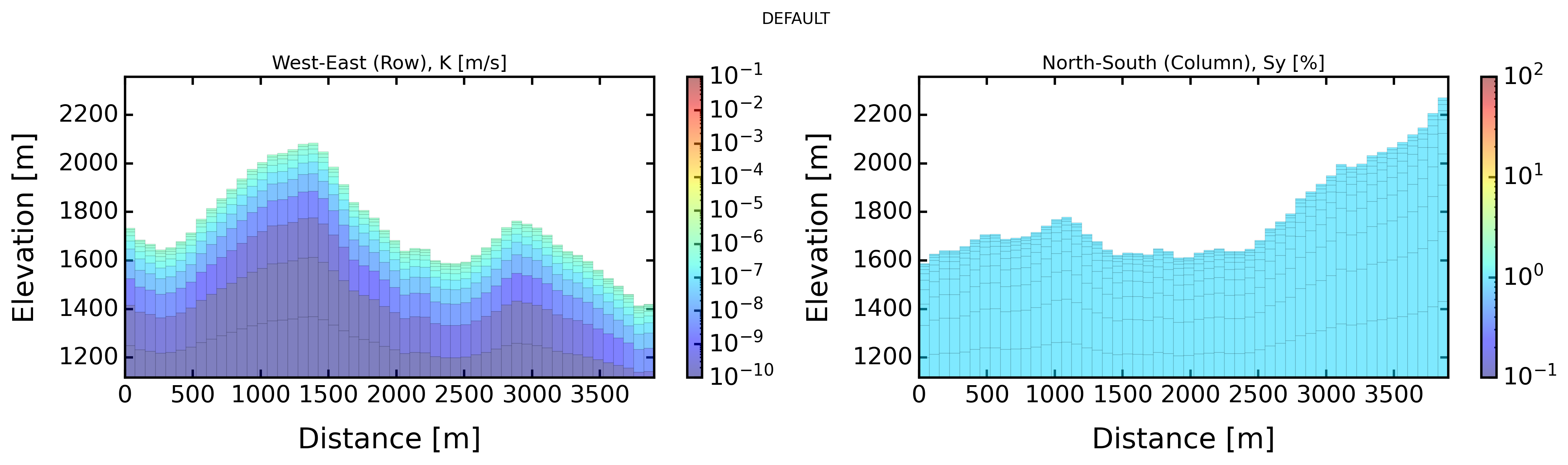
BV.settings.update_check_model(plot_cross=plot_cross)

# Climatic settings
BV.climatic.update_recharge(recharge, sim_state=sim_state)
BV.climatic.update_first_clim(first_clim)

# Hydraulic settings
BV.hydraulic.update_nlay(nlay) # 1
BV.hydraulic.update_lay_decay(lay_decay) # 1
BV.hydraulic.update_bottom(bottom) # None
BV.hydraulic.update_thick(thick) # 30 / intervient pas si bottom != None
BV.hydraulic.update_hk(hk)
BV.hydraulic.update_sy(sy)
BV.hydraulic.update_ss(ss)
BV.hydraulic.update_cond_drain(cond_drain)
BV.hydraulic.update_hk_decay(1/50, min_value=1e-10*24*3600, log_transf=False)

# Boundary settings
BV.settings.update_bc_sides(bc_left, bc_right)
BV.add_oceanic(sea_level)
BV.settings.update_dis_perlen(dis_perlen=dis_perlen)
[INFO] Initializing settings module for groundwater parameters
[INFO] Initializing climatic module parameters
[INFO] Initializing hydraulic module for parameter setup
[ ]:
model_modflow = BV.preprocessing_modflow(for_calib=False)
success_modflow = BV.processing_modflow(model_modflow, write_model=True, run_model=True)
if success_modflow == True:
    BV.postprocessing_modflow(model_modflow,
                              watertable_elevation = True,
                              watertable_depth= True,
                              seepage_areas = True,
                              outflow_drain = True,
                              groundwater_flux = True,
                              groundwater_storage = True,
                              accumulation_flux = True,
                              persistency_index = False,
                              intermittency_monthly = False,
                              intermittency_daily = False,
                              export_all_tif = False)
[WARNING] MODFLOW grid connectivity check found 3889 problematic cells
FloPy is using the following executable to run the model: ../../../../../bin/linux/mfnwt

                                  MODFLOW-NWT-SWR1
    U.S. GEOLOGICAL SURVEY MODULAR FINITE-DIFFERENCE GROUNDWATER-FLOW MODEL
                             WITH NEWTON FORMULATION
                             Version 1.3.0 07/01/2022
                    BASED ON MODFLOW-2005 Version 1.12.0 02/03/2017

                    SWR1 Version 1.05.0 03/10/2022

 Using NAME file: default.nam
 Run start date and time (yyyy/mm/dd hh:mm:ss): 2025/11/12  1:42:37

 Solving:  Stress period:     1    Time step:     1    Groundwater-Flow Eqn.
[INFO] Post-processing stress period 1/1
 Run end date and time (yyyy/mm/dd hh:mm:ss): 2025/11/12  1:42:38
 Elapsed run time:  0.705 Seconds

  Normal termination of simulation
[INFO] Exporting watertable elevation time series
[INFO] Exporting watertable depth time series
[INFO] Exporting seepage areas time series
[INFO] Exporting outflow drain time series
[INFO] Exporting groundwater flux time series
[INFO] Exporting groundwater storage time series
[INFO] Exporting accumulation flux time series
[ ]:
# Prepare particle tracking from seepage inside the catchment studied
tif_seep = BV.simulations_folder + '/' + model_name + '/_postprocess/_rasters/seepage_areas_t(0).tif'
tif_seep_clip = BV.simulations_folder + '/' + model_name + '/_postprocess/_rasters/seepage_areas_t(0)_clip.tif'
wbt.clip_raster_to_polygon(
    tif_seep,
    BV.stable_folder + '/geographic/watershed.shp',
    tif_seep_clip,
    maintain_dimensions=True)

# Prepare particle tracking from synthetic boreoles across the catchment
bore = imageio.imread(BV.geographic.watershed_box_buff_dem)
bore = bore*0
bore[26,34] = 1
bore[20,20] = 1
bore[40,48] = 1
bore[38,22] = 1
bore[28,21] = 1
particles_folder = os.path.join(BV.simulations_folder + '/' + model_name, '_postprocess', '_particles')
toolbox.create_folder(particles_folder)
toolbox.export_tif(BV.geographic.watershed_box_buff_dem,
                   bore,
                   BV.geographic.simulations_folder+'/'+model_name+'/'+'_postprocess/_particles/'+'synthetic_boreholes.tif',
                   0)
tif_bore = BV.geographic.simulations_folder+'/'+model_name+'/'+'_postprocess/_particles/'+'synthetic_boreholes.tif'

BV.settings.update_input_particles(#zone_partic = tif_seep,
                                   zone_partic = tif_bore,
                                   cell_div = 1, # 1
                                   zloc_div = True,  # or True, add cells at cell bottom
                                   bore_depth = True, # '[0,5,10] for 3 particles or None
                                   track_dir = 'backward',
                                   # track_dir = 'forward',
                                   sel_random = None, # or int
                                   sel_slice = None, # or int
                                   )

if sim_state == 'steady':
    if success_modflow == True:
        model_modpath = BV.preprocessing_modpath(model_modflow)
        success_modpath = BV.processing_modpath(model_modpath, write_model=True, run_model=True)
    if success_modpath == True:
        BV.postprocessing_modpath(model_modpath,
                                  ending_point=True,
                                  starting_point=True,
                                  pathlines_shp=True,
                                  particles_shp=False,
                                  random_id=None, # select randomly to save (for pathlines and particles)
                                  ) # None

        BV.filtprocessing_modpath(model_modpath,
                                  norm_flux=True, # for forward only
                                  filt_time=True, # delete particles with time at 0, add a column with time divided by 365 (considering recharge in days)
                                  filt_seep=True, # only forward, keep only particles finishing in zone1 (seepage), keep only particles finishing in k1 (first layer)
                                  filt_inout=True, # delete particles in and out in the same cell (first layer)
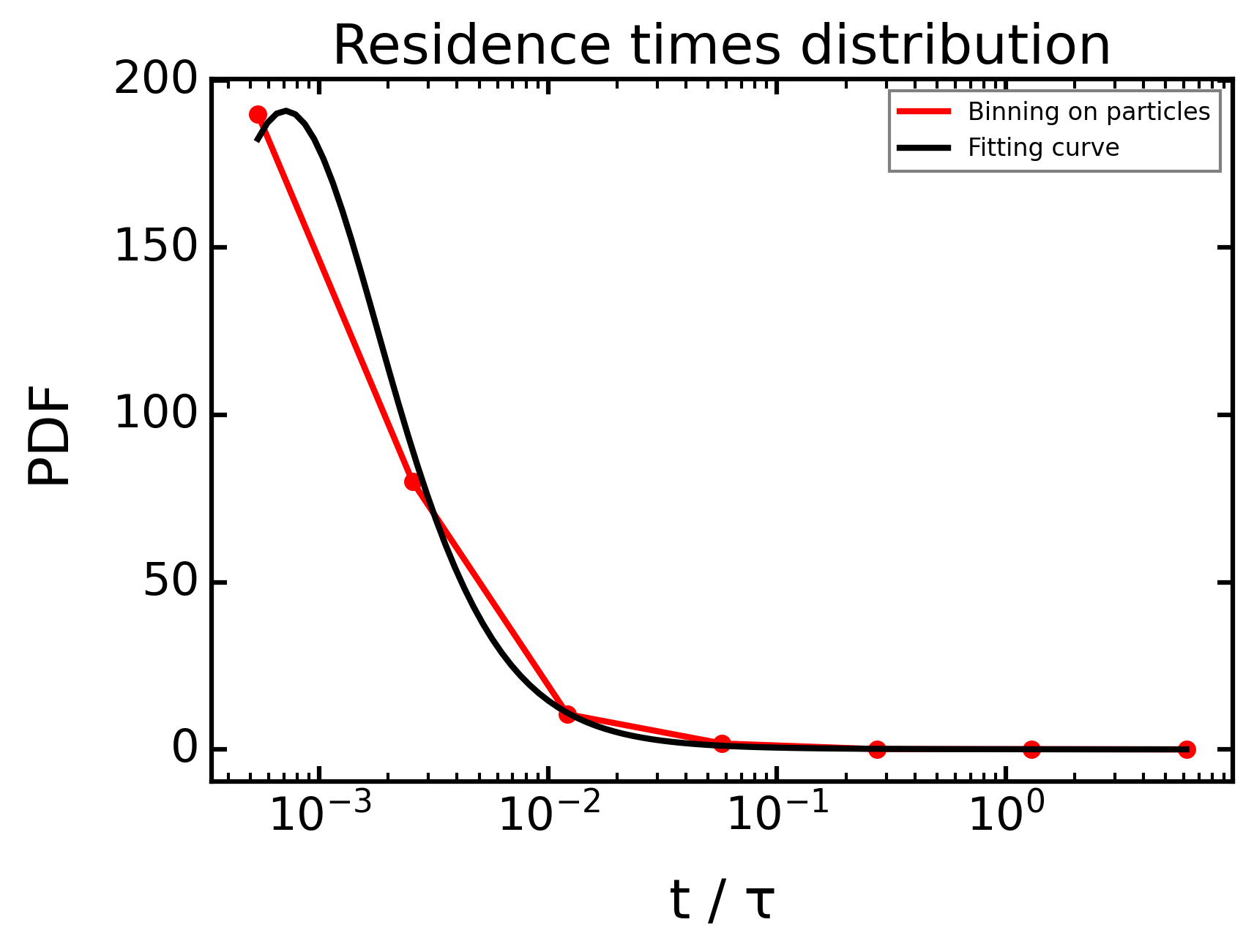
                                  calc_rtd=True, # compute residence time distribution
                                  random_id=None, # select randomly to keep
                                  ) # None
writing loc particle data
FloPy is using the following executable to run the model: ../../../../../bin/linux/mp6
Processing basic data ...
Checking head file ...
Checking budget file and building index ...

Run particle tracking simulation ...
Processing Time Step     1 Period     1.  Time =  1.00000E+00
Particle tracking complete. Writing endpoint file ...
End of MODPATH simulation. Normal termination.
(numpy.record, [('particleid', '<i4'), ('particlegroup', '<i4'), ('timepointindex', '<i4'), ('cumulativetimestep', '<i4'), ('time', '<f4'), ('x', '<f4'), ('y', '<f4'), ('z', '<f4'), ('k', '<i4'), ('i', '<i4'), ('j', '<i4'), ('grid', '<i4'), ('xloc', '<f4'), ('yloc', '<f4'), ('zloc', '<f4'), ('linesegmentindex', '<i4')])
[ ]:
timeseries_results = BV.postprocessing_timeseries(model_modflow=model_modflow,
                                                  model_modpath=model_modpath,
                                                  datetime_format=False,
                                                  subbasin_results=True) # or None
[INFO] Exported catchment time series to /home/bb/Documents/01_Git_Repository/01-HydroModPy-dev/examples/results/Example_06_Lasset/results_simulations/default/_postprocess/_timeseries
[ ]:
# if sim_state == 'steady':
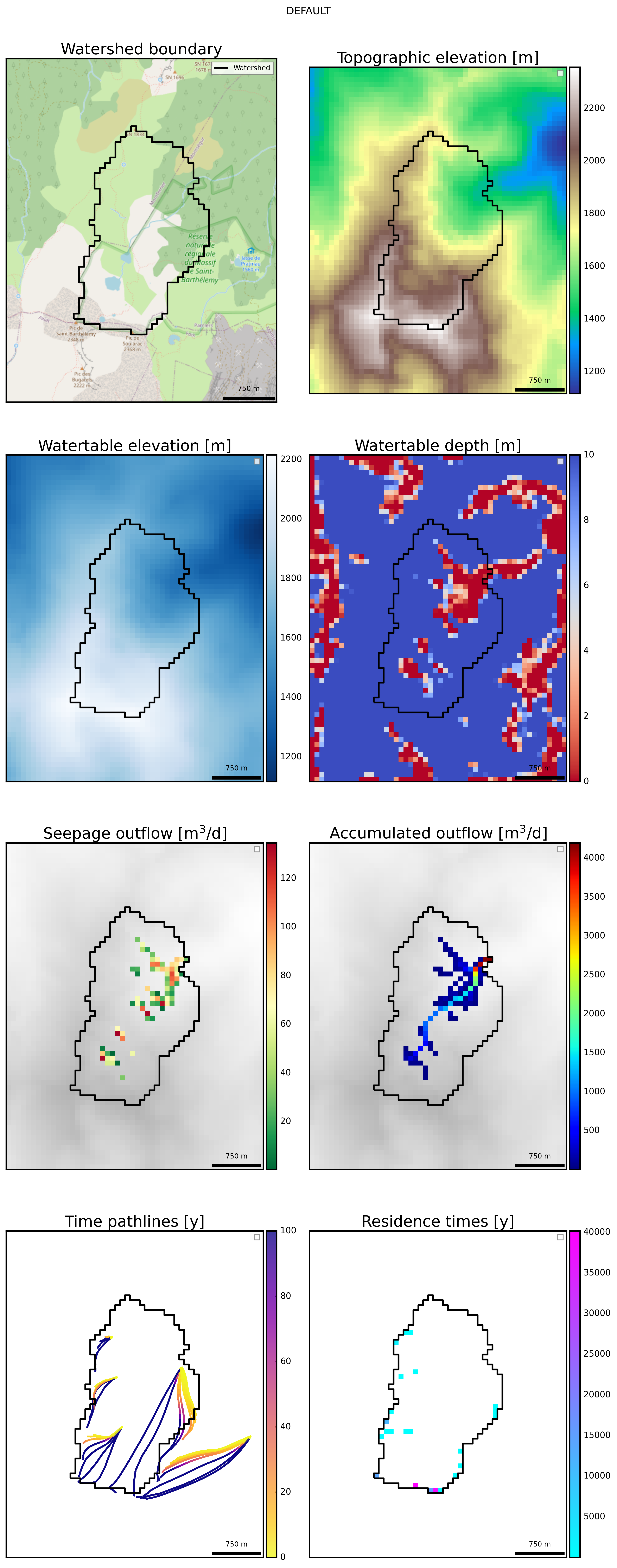
visu = visualization_results.Visualization(BV, model_name)
visu.visual2D(object_list = ['map','grid',
                             'watertable', 'watertable_depth',
                             'drain_flow','surface_flow',
                             'pathlines', 'residence_times'
                             ],
              color_scale = [(None,None),(None,None),
                             (None,None),(0,10),
                             (None,None),(None,None),
                             (0,100),(None,None),
                             ],
              lines=500)
[INFO] Plotting 2D map visualizations for model default
[14]:
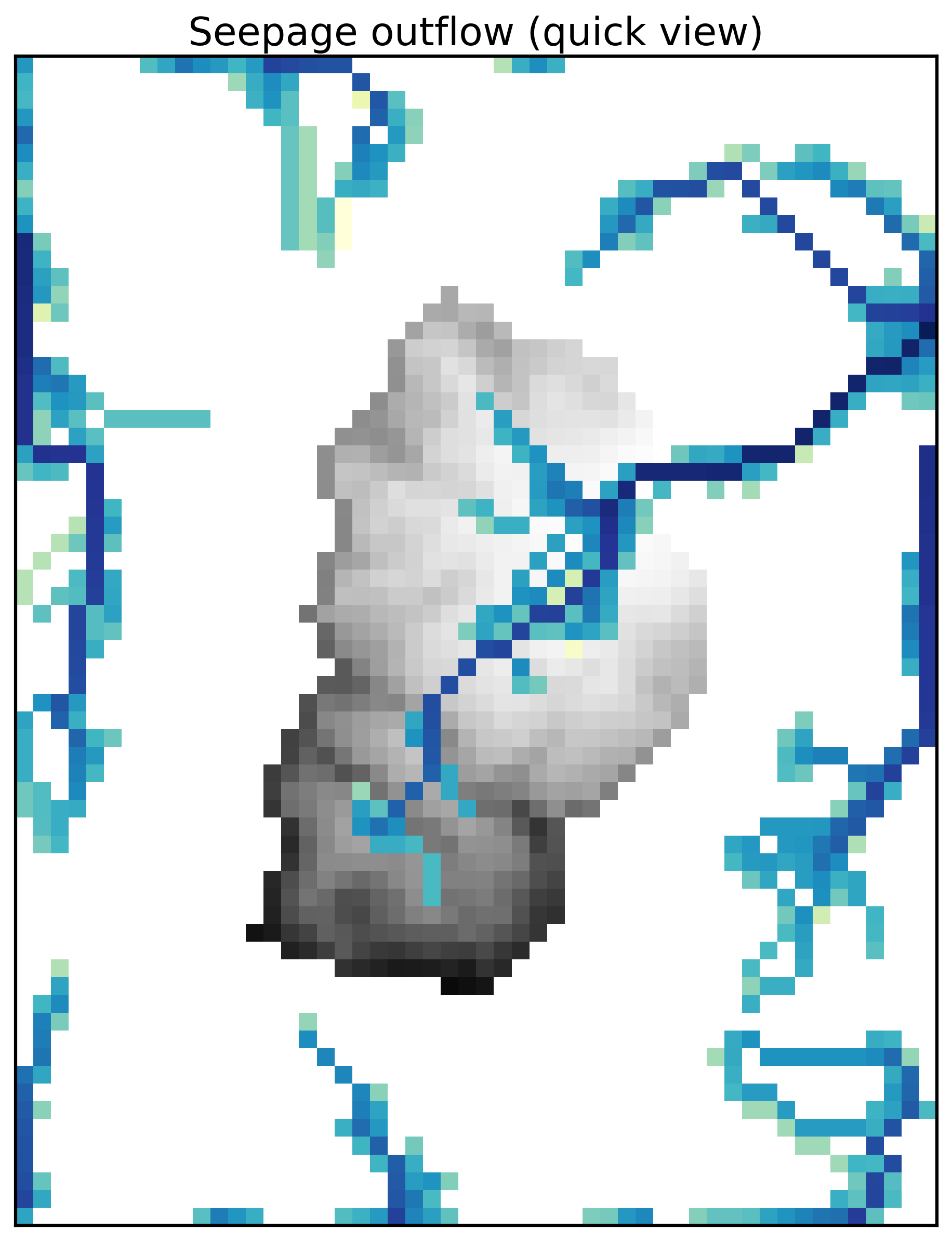
lead_numb = '0'
outflow = imageio.imread(simulations_folder+model_name+'/_postprocess/_rasters/accumulation_flux_t(0).tif')
demData = imageio.imread(BV.geographic.watershed_dem)
demData = np.ma.masked_array(demData, mask=demData<0)
res = BV.geographic.resolution

msk_outflow = (outflow<0)
outflow = np.ma.masked_array(outflow, mask=msk_outflow)
outflow = ( np.ma.masked_where(outflow==0, outflow) / (res**2) )
outflow = outflow * 1000 * 365 # mm/year
outflow = np.log10(outflow)

from matplotlib.colors import LightSource
ls = LightSource(azdeg=45, altdeg=45)
cmap = plt.cm.Greys
rgb = ls.shade(demData, cmap=cmap, blend_mode='soft', vert_exag=2, dx=res, dy=res)

fig, ax = plt.subplots(1, 1, figsize=(8,8))
ax.get_xaxis().set_visible(False)
ax.get_yaxis().set_visible(False)
im = ax.imshow(demData, alpha=0.8, cmap=cmap)
im = ax.imshow(rgb, alpha=0.8, cmap=cmap)
cf=ax.imshow(outflow, cmap='YlGnBu', alpha=1, vmin=outflow.min(), vmax=outflow.max())
ax.set_title('Seepage outflow (quick view)')

name_fig = 'map_discharge_' + str(lead_numb) + '.png'
plt.tight_layout()

# fig.savefig(os.path.join(simulations_folder, model_name,
#                             '_postprocess', '_figures', 'RAW_'+model_name+'.png'))
[ ]:
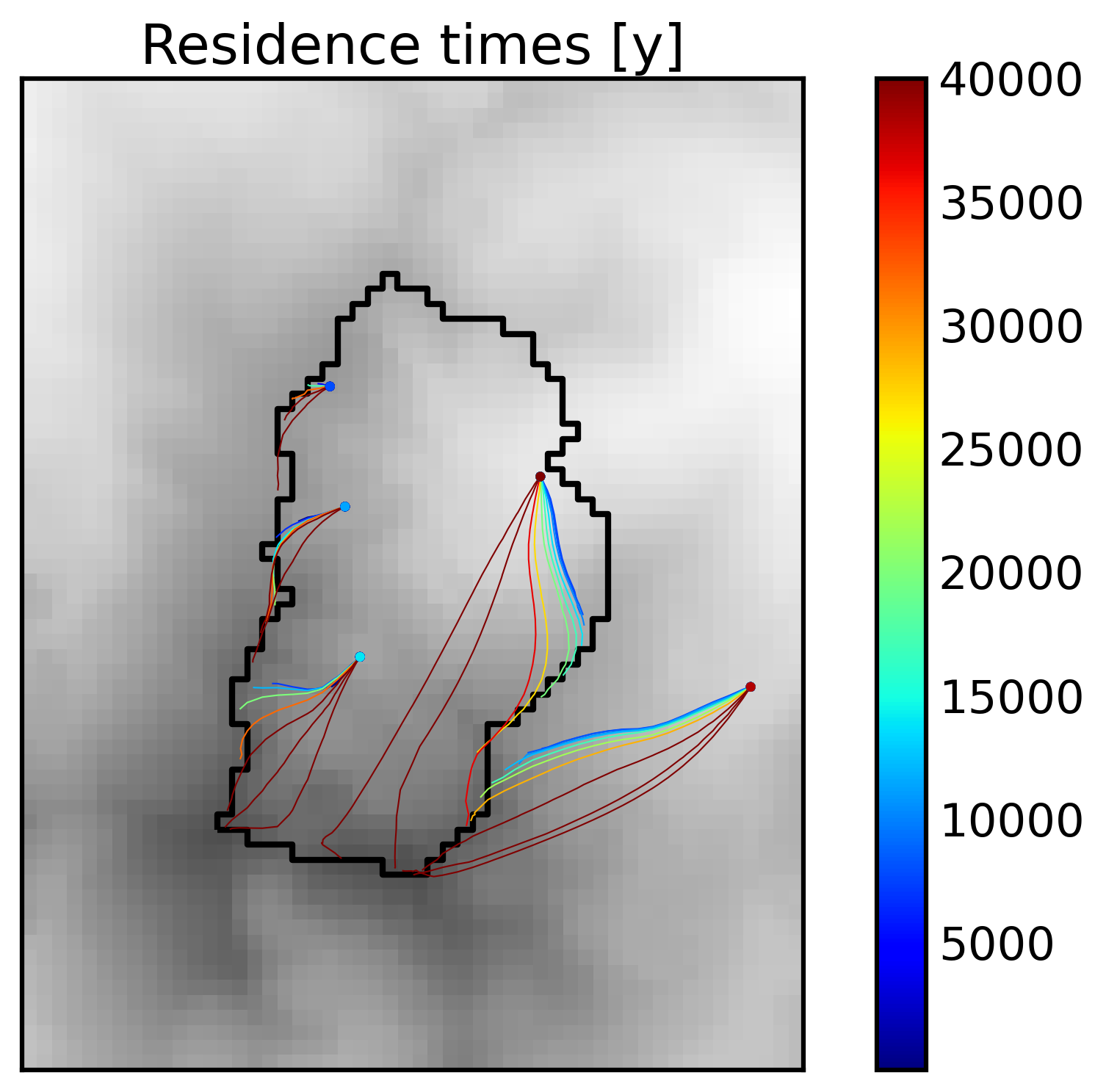
shp_pathlines = gpd.read_file(simulations_folder+model_name+'/_postprocess/_particles/pathlines_weighted.shp')
# shp_endpoints = gpd.read_file(simulations_folder+model_name+'/_postprocess/_particles/starting_weighted.shp')
shp_endpoints = gpd.read_file(simulations_folder+model_name+'/_postprocess/_particles/starting_weighted.shp')

try:
    line = gpd.read_file(stable_folder+'geographic/'+'watershed_contour.shp')
except:
    pass

dem_rio = rasterio.open(BV.geographic.watershed_box_buff_dem)
dem_data = dem_rio.read(1)
dem_data = np.ma.masked_where(dem_data < 0, dem_data)

fig, ax = plt.subplots(1,1, figsize=(7,5))

rasterio.plot.show(dem_data, ax=ax, transform=dem_rio.transform,
                    cmap='Greys', alpha=0.7, zorder=-10)

shp_pathlines.plot(ax=ax, column='time_win_y', cmap='jet', lw=0.5,
                   norm=mpl.colors.LogNorm(vmin=1, vmax=1000),
                   zorder=1)

shp_endpoints.plot(ax=ax, column='time_win_y', cmap='jet', lw=0, markersize=10,
                   # norm=mpl.colors.LogNorm(vmin=0.1, vmax=1000),
                   legend=True,
                   zorder=2)

try:
    line.plot(ax=ax, color='k', lw=2, zorder=-1)
except:
    pass

ax.set_title('Residence times [y]')

ax.get_xaxis().set_visible(False)
ax.get_yaxis().set_visible(False)

fig.tight_layout()

# fig.savefig(os.path.join(simulations_folder, model_name,
#                             '_postprocess', '_figures', 'RTD_'+model_name+'.png'))
[ ]:
os.chdir(root_dir)

# wbt.geomorphons(
#     'xxx/watershed_box_buff_dem.tif',
#     'xxx/watershed_box_geomorphons.tif',
#     search=5, # in cell
#     threshold=0, # angle in degree
#     fdist=0, # in cell
#     skip=0, # in cell
#     forms=True,
#     residuals=False,
# )